


Implantology in Barcelona
Dental implants with virtually painless surgery and excellent results
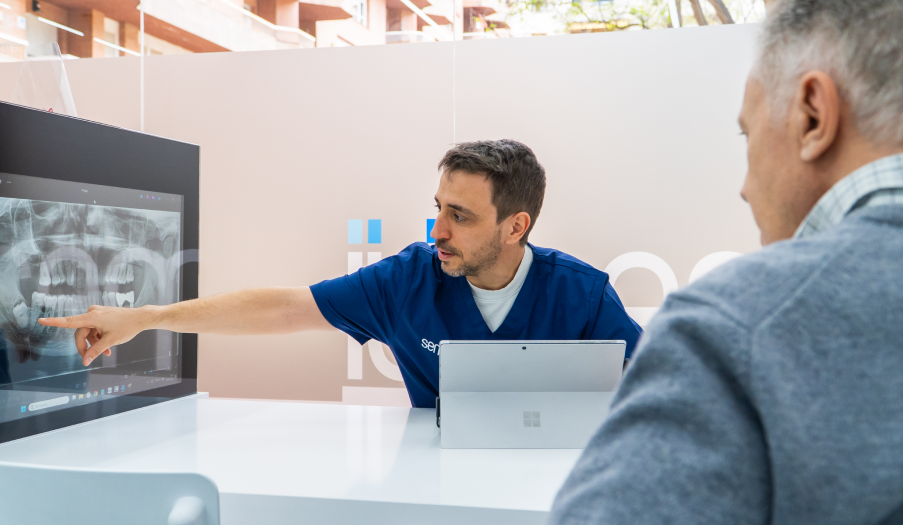
Missing teeth can cause a variety of problems, including aesthetic impairment and unwanted movement or twisting of neighboring teeth (on the sides and above/below).
It's important to emphasize that the quality of the materials used in implantology is very important. Implant success rates vary greatly from brand to brand. At Semüi, we work with the highest quality implants and always plan their placement using a CBCT scan and computer guidance.
Replacing the missing tooth protects the bone, maintains the alignment of the teeth, and prevents the need for much more expensive treatments later on.
Frequently Asked Questions
What is a CBCT?
A radiological test that surpasses the CT scan in several aspects:
- The radiation dose is much lower. To match the radiation received from a conventional CT scan, more than 70 CBCT scans are required.
- The test is performed with the patient standing or sitting, and does not cause claustrophobia.
- The test takes 2 minutes to complete, and the image can be viewed immediately.
- The image obtained is 3-dimensional and not distorted.
- The image allows for the superposition of other images, such as those of the patient's future teeth, allowing for completely precise implant planning.
What if I have several missing teeth?
Typically, the placement of multiple implants will be a two-stage process: initially, the implants are placed and a conventional removable prosthesis is worn, and after months of healing and osseointegration, the prosthesis anchored to the implants is placed.
What do I do with the space when I'm missing a tooth?
You can leave that space, but you should know that:
- Depending on the area, it may be unattractive.
- It can affect your eating, speech, and confidence.
- The bone and gum in the gap will reduce in volume.
- Adjacent and upper/lower teeth will move and make oral hygiene difficult.
If you decide to build a conventional bridge you should know
- Healthy adjacent teeth must be ground down to support the bridge, compromising their long-term health.
- The bone that supports the gum underneath will shrink due to lack of use.
- The abutment teeth receive additional stress during chewing.
- It is an option of choice depending on the patient's health status.
Single crown on an implant
- It looks and functions just like a natural tooth.
- It is not necessary to damage the adjacent healthy teeth.
- Continued implant use prevents resorption of the underlying bone, improving the condition of your jawbones for the future.
- Prevents adjacent teeth from moving.
- Long-term success is very high and predictable (98%) with proper maintenance: good oral hygiene at home, and regular check-ups at the clinic.
When might I need an implant?
- You are missing more than one tooth.
- You have ill-fitting dentures or a failing bridge.
- You are not able to chew properly and cannot eat what you want.
- You feel your teeth moving.